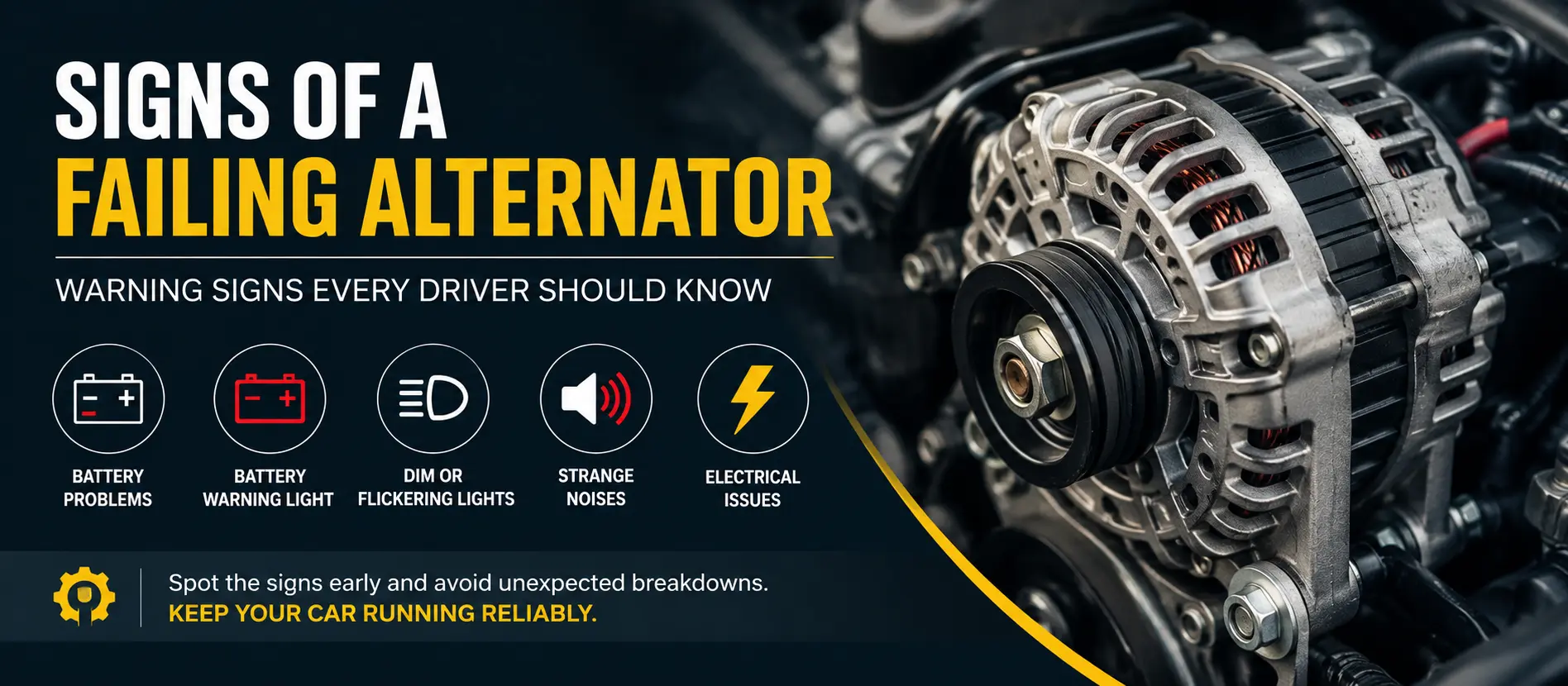
You pull up to a traffic light, and your engine starts to sputter. Your dashboard lights flicker, and the radio suddenly cuts out. Moments like these cause instant panic for any driver. While a dead battery often gets the blame, the real culprit is frequently the part tasked with keeping that battery charged: the alternator. This critical engine component works full-time to power your car’s electrical systems while you drive. When it begins to struggle, it creates a chain reaction of failures that can leave you stranded. Learning to spot the early warning signs of a failing alternator is the best way to prevent an expensive roadside emergency.
The alternator is the heart of your vehicle’s electrical system. It generates power to run your headlights, radio, air conditioning, and power windows. Because these parts rely on a steady flow of electricity, they are often the first to show you that something is wrong. When the alternator output drops, these systems receive less power than they need to function properly.
Your lights are a direct reflection of your car’s electrical health. A healthy charging system provides a constant voltage of around 13.5 to 14.5 volts while the engine runs. If the alternator is dying, this voltage drops. You will notice your headlights looking yellow or dim compared to their usual brightness.
This issue often gets worse when your engine idles. At low engine speeds, the alternator spins slower and produces less power. You might see your dome lights or dashboard lights glow brighter when you step on the gas and fade back down when you slow to a stop. If your lights behave this way, it is a classic sign that the charging system is losing its grip.
Modern cars are packed with electronics that demand a lot of power. When the alternator cannot keep up with this demand, you will notice strange behavior in your vehicle’s accessories. Power windows might crawl up the door frame at a snail’s pace. Your radio might shut off or reset on its own. If you have heated seats, they may fail to warm up or cycle on and off.
These accessories draw significant current. A failing unit simply lacks the capacity to supply enough energy for all these parts at once. If you notice your windows slowing down or the blower motor in your air conditioner blowing weaker than normal, do not ignore it. These symptoms often start as intermittent glitches before they turn into a full system failure.
Many drivers assume a battery-shaped light on the dashboard means it is time for a new battery. While that can be true, the indicator is actually a general warning for the entire charging system. It does not just track the battery’s charge level; it also monitors the output coming from the alternator.
When the alternator stops sending enough voltage to the battery, the car’s computer senses this gap and turns on the battery warning light. This light is your car’s way of saying it is currently running on the battery’s stored energy alone. Because a battery only holds enough power to run the car for a short time, you have limited minutes to find a safe place to stop once this light appears.
Many drivers make the mistake of replacing the battery immediately. While a new battery might get the car started again, it will quickly drain because the faulty alternator cannot recharge it. Always treat the battery light as a warning that the charging system is not doing its job.
A solid battery light is a clear signal that the charging system has stopped working. If the light comes on and stays on while you are driving, pull over to a safe area as soon as you can. Continuing to drive will eventually exhaust the battery, leading to a complete engine stall.
A flashing battery light can be even more confusing. It often indicates that the alternator is providing intermittent power. It might be working one second and failing the next, or the voltage output might be erratic. Both scenarios indicate a part on the verge of total failure. Never assume a flashing light will go away on its own.
Because the alternator contains spinning parts and relies on a belt, it often makes noise before it completely gives up. If you hear sounds coming from the front of your engine, pay attention to how they change with engine speed.
A whining noise that gets louder as you rev the engine is often a symptom of worn-out bearings inside the alternator. These bearings allow the internal shaft to spin smoothly. Once they wear down or run out of lubricant, they create a high-pitched whine.
A squealing noise is another common indicator. This might mean the belt driving the alternator is slipping on the pulley. If the pulley itself is seized or damaged, it creates drag, causing the belt to squeal in protest. While this sound can sometimes be confused with a bad power steering pump, the key is the location of the sound. If the noise is coming from the alternator housing, you know where the problem lies.
Grinding noises are more serious than a simple whine. They usually suggest that an internal component has suffered a mechanical failure. It might be a bearing that has broken apart or a loose internal fan blade hitting the casing.
Rattling sounds can also happen if the alternator is not secured properly. If the bolts holding it to the engine have worked loose, the unit will vibrate against the engine block. A loose alternator can cause damage to other parts and eventually snap the drive belt. If you hear grinding or rattling, get the car inspected immediately to avoid a breakdown.
Your engine needs a constant supply of electricity to run. Spark plugs need to fire, and fuel injectors need to pulse. All of these systems take their power from the charging circuit. When the alternator fails, the engine effectively begins to starve for electricity.
When the voltage drops too low, your engine’s computer struggles to keep the car running. You might feel the car hesitate or jerk during acceleration. In severe cases, the engine will simply shut off. This often happens at intersections or in stop-and-go traffic where the engine is idling. Without enough power to keep the ignition and fuel systems active, the car cannot keep itself running. If your car stalls unexpectedly, the charging system is one of the first things you should check.
A bad alternator makes it hard to start your car. If the alternator failed to charge the battery during your last drive, the battery will not have enough power to turn the starter motor. You might hear the engine click or crank very slowly when you turn the key.
If you get a jump-start and the car runs for a while before dying again, the alternator is almost certainly the problem. The jump-start gives the battery enough boost to get going, but because the alternator cannot refill that charge, the battery dies as soon as you disconnect the cables or drive a few miles.
If you notice any of the signs listed above, take action quickly. Ignoring these symptoms will not make them go away; they will only lead to more damage and a higher repair bill later.
If you feel comfortable under the hood, you can perform a few simple checks. First, check the belt that drives the alternator. Look for cracks, fraying, or loose tension. A bad belt can prevent a perfectly good alternator from working.
You can also use a multimeter to test your charging system. With the engine off, touch the probes to the battery terminals. A healthy battery should read around 12.6 volts. Start the engine and test the terminals again. The voltage should jump to somewhere between 13.7 and 14.7 volts. If the voltage does not increase while the engine is running, your alternator is not charging.
If you are not sure about your findings, visit a qualified mechanic. Shops have specialized testers that can put a “load” on the alternator to see if it can handle the electrical demand of your car. This is more accurate than a simple voltage check. Do not try to drive long distances with a known charging issue, as you will likely be stranded when the battery finally runs out of power.
You can help your alternator last longer by keeping up with routine maintenance. Keep your battery terminals clean and tight; a bad connection forces the alternator to work harder to push electricity through. Replace your serpentine belt according to your owner’s manual. A belt that is too loose or too tight puts extra stress on the alternator bearings. Finally, avoid running heavy electrical loads like high-powered aftermarket audio systems if your car is not equipped to handle them.
Your car relies on the alternator to keep every system running, from your headlights to your engine’s computer. The signs of a failing alternator—dimming lights, strange noises, and unexpected stalls—are your vehicle’s way of asking for help. By staying observant and checking your charging system at the first hint of trouble, you can avoid the frustration of a breakdown. Keep your electrical system in good shape, and you will stay safely on the road.